A manager that sets the envelope. A module that holds it.
Two coordinated layers for closed-loop AI rack power orchestration — ORv3 / ORW today, designed for Mt Diablo ±400 VDC / 800 VDC.
Facility-level layer that sets the power envelope for each rack from grid conditions and site policy, and records compliance evidence per rack.
INTERFACES
- Redfish API — telemetry ingestion
- PMBus — power shelf control
- POM interface — rack coordination
Interface contributed to OCP Rack & Power as POM
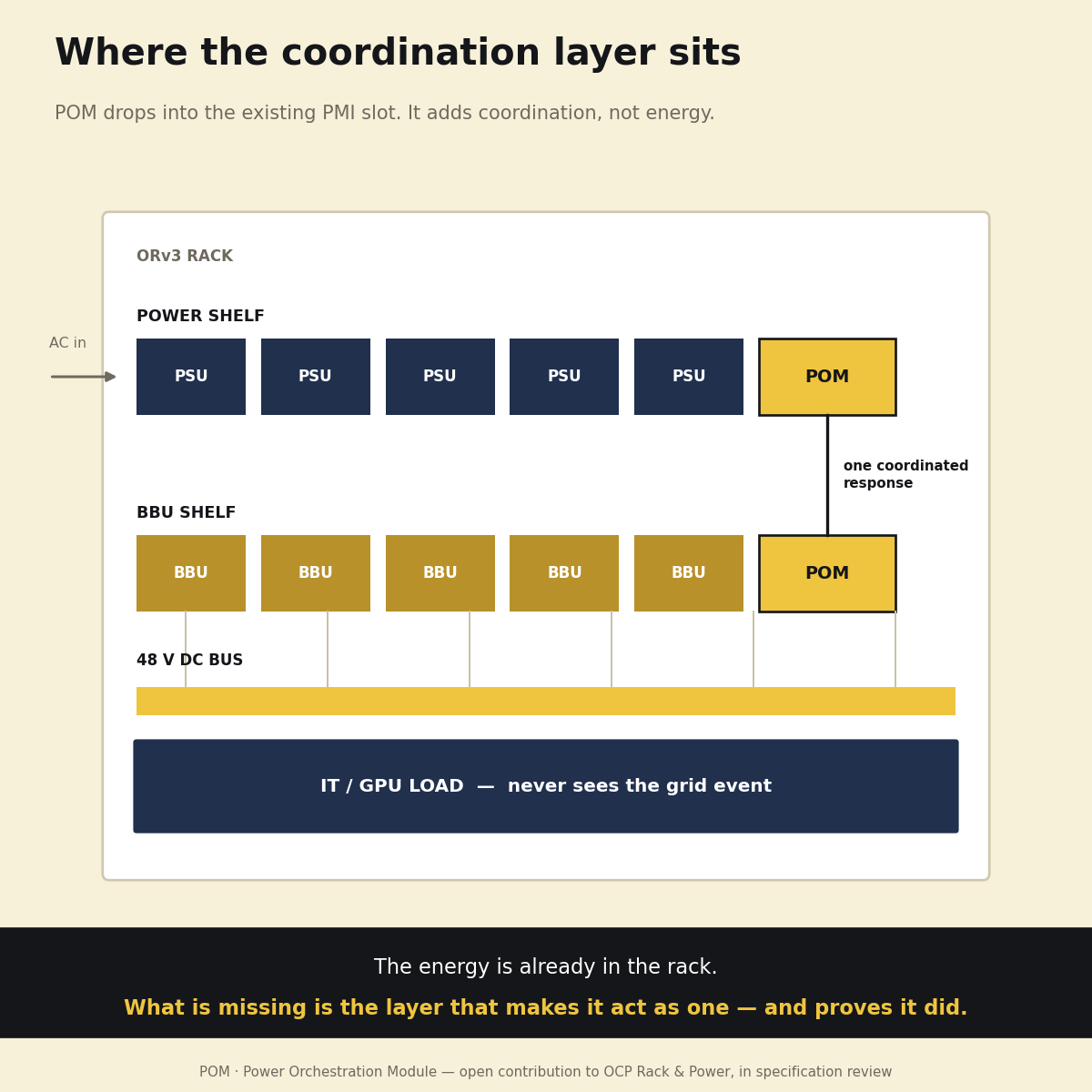
Rack-mounted module that coordinates BBU discharge and PSU output inside the ORv3 power shelf. Installs in the PMI-class slot with its own control plane, and keeps operating autonomously if the facility layer is unreachable.
INTERFACES
- ORv3 power shelf, PMI-class slot
- SMBus + PMBus control
- Real-time BBU + PSU coordination
Reference implementation of POM
CONTROL LOOP
How XMight's POM implementation responds
ARCHITECTURE
Set the envelope, coordinate the rack, prove it.
XMight's POM implementation sits between the data center EMS and the ORv3 rack. The diagram below shows POM (Power Orchestration Module) — XMight's open contribution to OCP Rack & Power — and the two-layer architecture of the XMight POM Module and POM Manager.
Built on ORv3 / ORW racks today. POM is topology-agnostic and designed for Mt Diablo ±400 VDC and NVIDIA 800 VDC sidecar architectures, where one power rack feeds several IT racks and recovery concentrates on the power rack.
Conventional ORv3 rack power reserves 20–30% headroom for transient buffering — compute capacity permanently locked. Coordinated BBU discharge absorbs the spikes instead, so the reserve can shrink: XMight's OCP 2025 Active BBU paper models a 25–35% lower peak-to-average ratio. Throttling isn't eliminated; it's made smaller and continuous.
Source: ORv3 Base Specification headroom reservation values; XMight, The Active BBU: Dynamic Power Orchestration for Stable and Efficient ORv3 AI Racks, OCP Global Summit 2025 (Table I).
VOLTAGE EVENT RESPONSE
What happens to an ORv3 rack — with and without POM.
Two voltage event scenarios, four traces each. Left column: conventional ORv3 rack power. Right column: same scenario with the XMight POM Module coordinating BBU discharge and PSU output.
Without POM, PFC trips within milliseconds and PSU restart consumes 6–17 seconds — far beyond the PFAPR 2-second budget. With POM, the XMight POM Module detects the event locally, coordinates BBU discharge to hold the 48V busbar, and the PSU recovers along a slope that meets PFAPR. Same hardware, rack-level control layer.
Scenarios 2 and 4 (frequency excursion and brownout) are detailed in the XMight POM Module specification.
POWER FLOW
From GPU transient to grid-visible load.
XMight's POM implementation intercepts the transient before it propagates to the grid coupling point.
INDUSTRY ANALYSIS
Four gaps that close-the-loop control must address.
Mapped against current OCP ORv3 specifications. Each gap belongs to a different leaf-spec owner — none can be closed by a single vendor or a single spec change. XMight's POM implementation addresses all four at rack level.
PSU PFC low-voltage behaviour
ORv3 PSU operates 180–305 V AC; specification permits derating between 180–198 V. Below 180 V (~0.65 p.u. of 277 V), PFC shuts off in approximately 20 ms with 20 ms holdup. ERCOT NOGRR 282 requires the load to keep consuming down to 0.50 p.u. and to stay connected through deeper sags.
PSU controller power-on delay
PSU controller loses power on AC drop; on restart the ORv3 PSU specification adds a randomized 0–5.5 s power-on delay for inrush staggering, on top of a cold-boot of several seconds. ERCOT's PFAPR window is 2 seconds from voltage recovery — current behaviour cannot meet it.
BBU trigger condition
BBU Module 1.4 §4.5 specifies discharge trigger at busbar < 48.5 V for 2 ms. This covers full AC loss but does not provide coordinated voltage-sag support.
PMI interface scope
PMI Specification 1.0 §2 defines pass-through monitoring only. No write commands, no open rack-level read-write coordination path is currently defined.
The XMight POM Manager and POM Module are designed to close all four gaps at rack level, without requiring component-vendor coordination.
OCP INTEGRATION
POM: the open interface the XMight POM Module implements.
Our OCP contribution defines POM — a new module class in the PMI-class slot with its own control plane — together with the coordinated PSU, BBU and PMI amendments that grid ride-through needs: PSU input envelope, controller keep-alive and fast resume; BBU sag-triggered discharge; a read-write coordination path in PMI. The table maps each leaf spec to the requirement it must meet.
| Specification | Version | ERCOT requirement | Status |
|---|---|---|---|
| Open Rack V3 Base | 1.0 | VRTFRT |
Gap identified |
| Power Shelf | 1.0 | VRTPFAPR |
Gap identified |
| 48V PSU | 1.0 | VRTPFAPRFRT |
Gap identified |
| PMI | 1.0 | VRTPFAPR |
Gap identified |
| BBU Shelf | 1.1 | VRTPFAPR |
Gap identified |
| BBU Module | 1.4 | VRTPFAPR |
Gap identified |
| Modbus Register Map | 0.73 | PFAPR |
Under review |
The Active BBU: Dynamic Power Orchestration for Stable and Efficient ORv3 AI Racks
Presented at OCP Global Summit 2025
This paper describes the Active BBU architecture — the technical foundation of POM — and its role in enabling PFAPR compliance while reclaiming compute headroom traditionally reserved for transient buffering.