ESS is the muscle. Coordination is what's missing.
Grid codes define behavior at the point of interconnection. The energy to ride through is already in the rack; what ORv3 halls lack is the layer that makes thousands of devices behave as one auditable load.
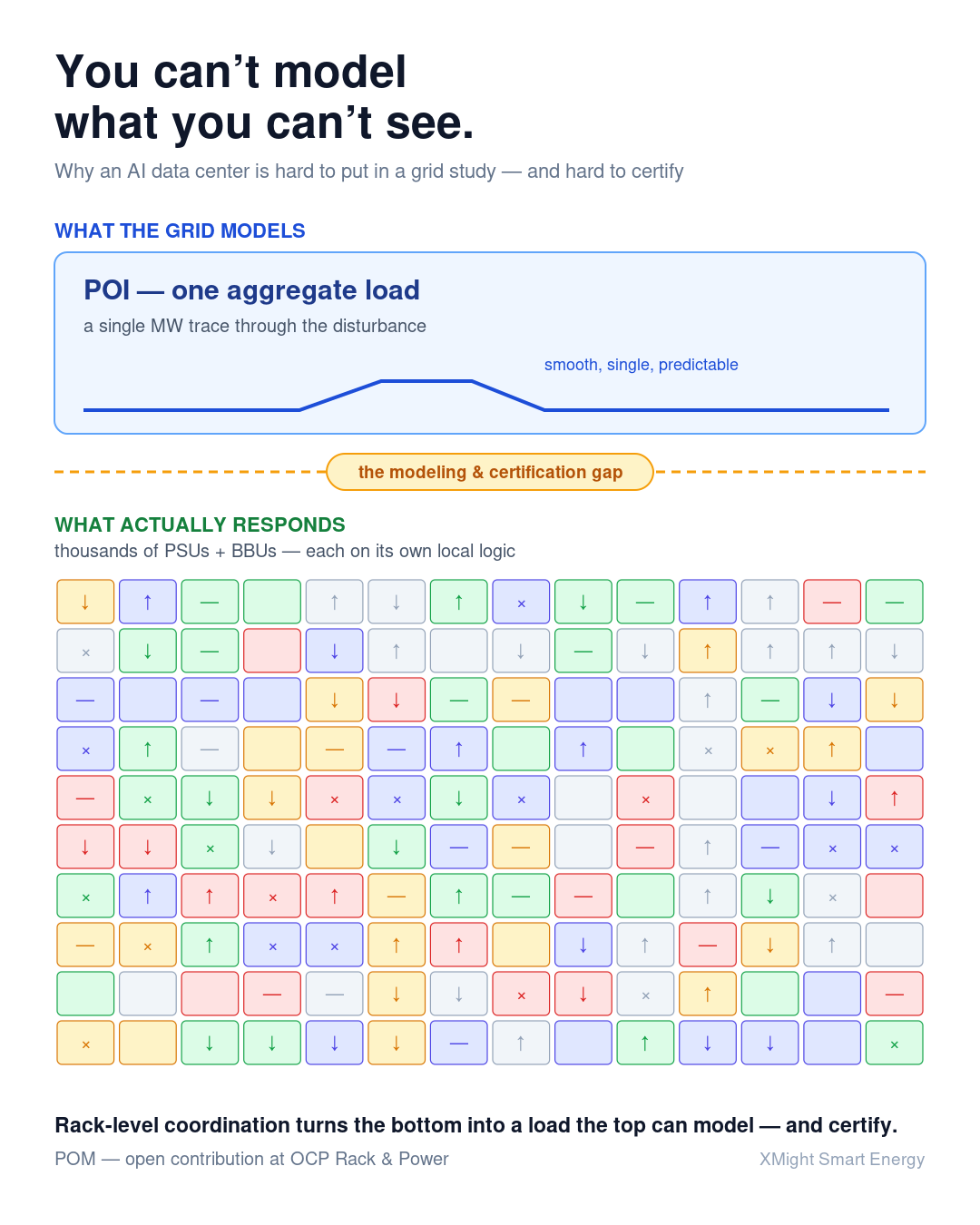
In May I wrote about ERCOT NOGRR 282 — ride-through below 0.35 p.u., a 2-second recovery window, in force since August 2026. Here's the structural follow-on for AI data center operators.
AI DC power architecture is shifting away from traditional facility-UPS designs. NVIDIA's 2025 800 VDC disclosure puts up to a 30% TCO improvement on the table versus today's 54 V DC-bus racks. OCP-native paths — ORv3 and ORW today, ±400 V Mt Diablo / ±800 V LVDC tomorrow — trade centralized facility UPS for distributed rack-tier power infrastructure. The direction is set: it's why hyperscalers and GPU Neoclouds choose this path.
But NOGRR 282, IESO TR v1.0 and NERC Project 2026-02 define behavior at the Point of Interconnection (POI). Whether the architecture is facility-UPS, facility-BESS or distributed-BBU, the compliance question is the same: ride through, recover within seconds, and prove it.
For OCP-native AIDC, an ESS upgrade — facility-side BESS, sidecar BESS or expanded rack-tier storage — is the obvious compliance muscle. But ESS alone, at any tier, runs into two structural problems:
- Oversizing risk. Without rack-level visibility, facility ESS gets sized against worst-case aggregated load — a capex overhead.
- Audit-trail gap. Grid operators increasingly need better real-time data, model validation and post-event evidence. Facility-level telemetry shows aggregate MW — but not which rack, PSU, BBU or control layer responded during the event.
And the obligation applies even to facilities with no facility-level battery at all. As the Data Center Coalition noted on the record, ERCOT's assumption that every facility has 1:1 backup energy isn't true — for a growing class of OCP-native facilities, ride-through energy isn't in a central UPS; it's distributed across rack PSUs and BBUs.
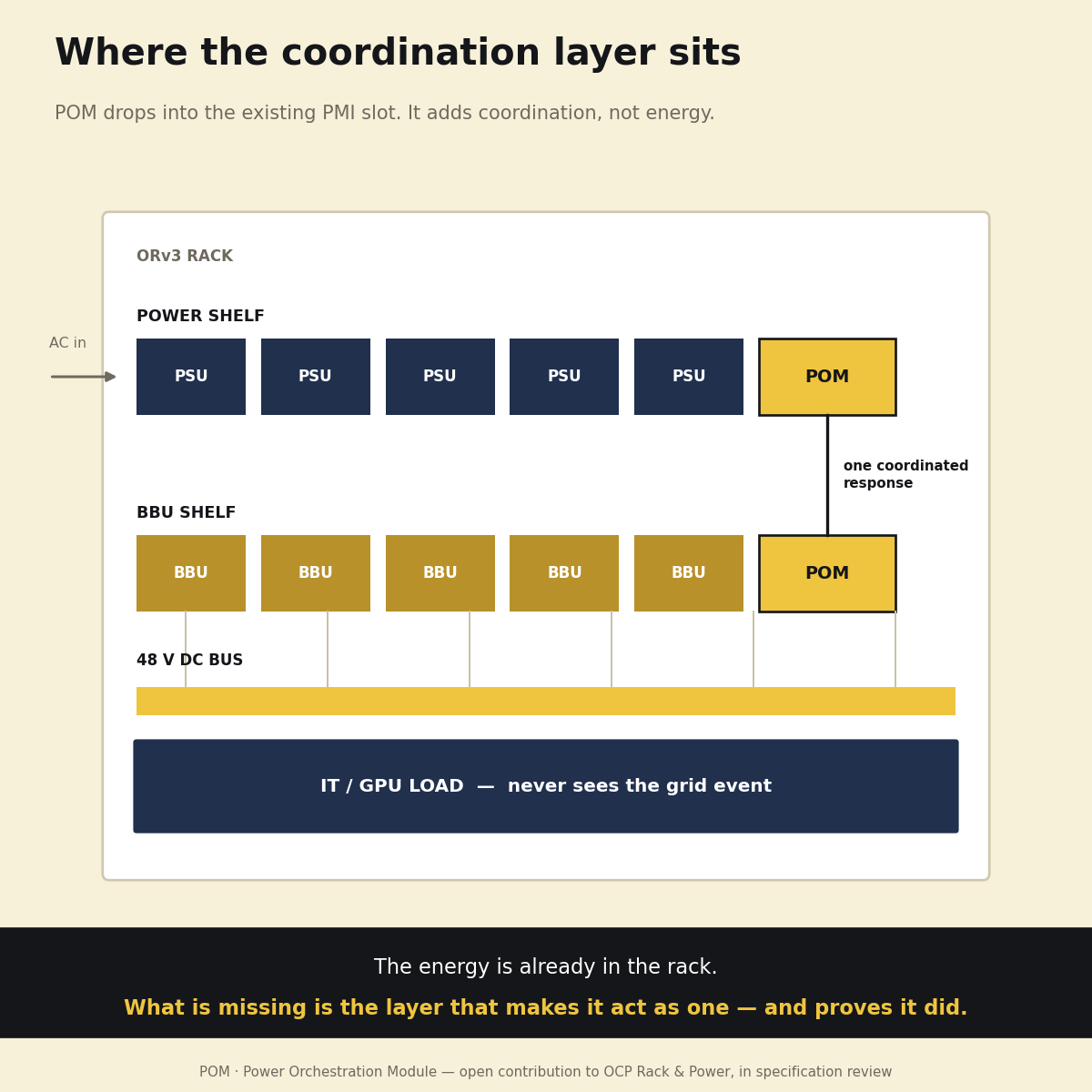
That reframes the compliance problem. The energy can be there — ESS is the muscle. What's missing is coordination: thousands of independent rack devices must behave as one predictable, recoverable, auditable load at the POI.
IEEE's IC25-004 points the same way: it calls for interoperability ensuring "consistent behavior across multi-vendor systems" so operators can rely on "predictable site-level responses."
That rack-to-facility coordination and observability layer is the part the industry hasn't built yet. It's the problem space we work on at XMight Smart Energy.
ESS provides the energy. Rack-level coordination turns distributed energy into verifiable grid behavior.
If you are working on ride-through, PFAPR, ESS sizing or rack-tier power architecture for large computational loads, we would be happy to compare notes.
References
- ERCOT NOGRR 282
- NERC, Reliability Guideline: Risk Mitigation for Emerging Large Loads (May 2026)
- IEEE IC25-004 (January 2026)
- NVIDIA, 800 VDC Architecture Will Power the Next Generation of AI Factories (2025)
- Data Center Coalition comments on NOGRR 282 (February 2026)