The power chain is getting shorter. The ride-through obligation is not.
Every deleted conversion stage spreads ride-through energy across more independent devices. Grid codes pull the other way: one aggregate, provable response at the meter.
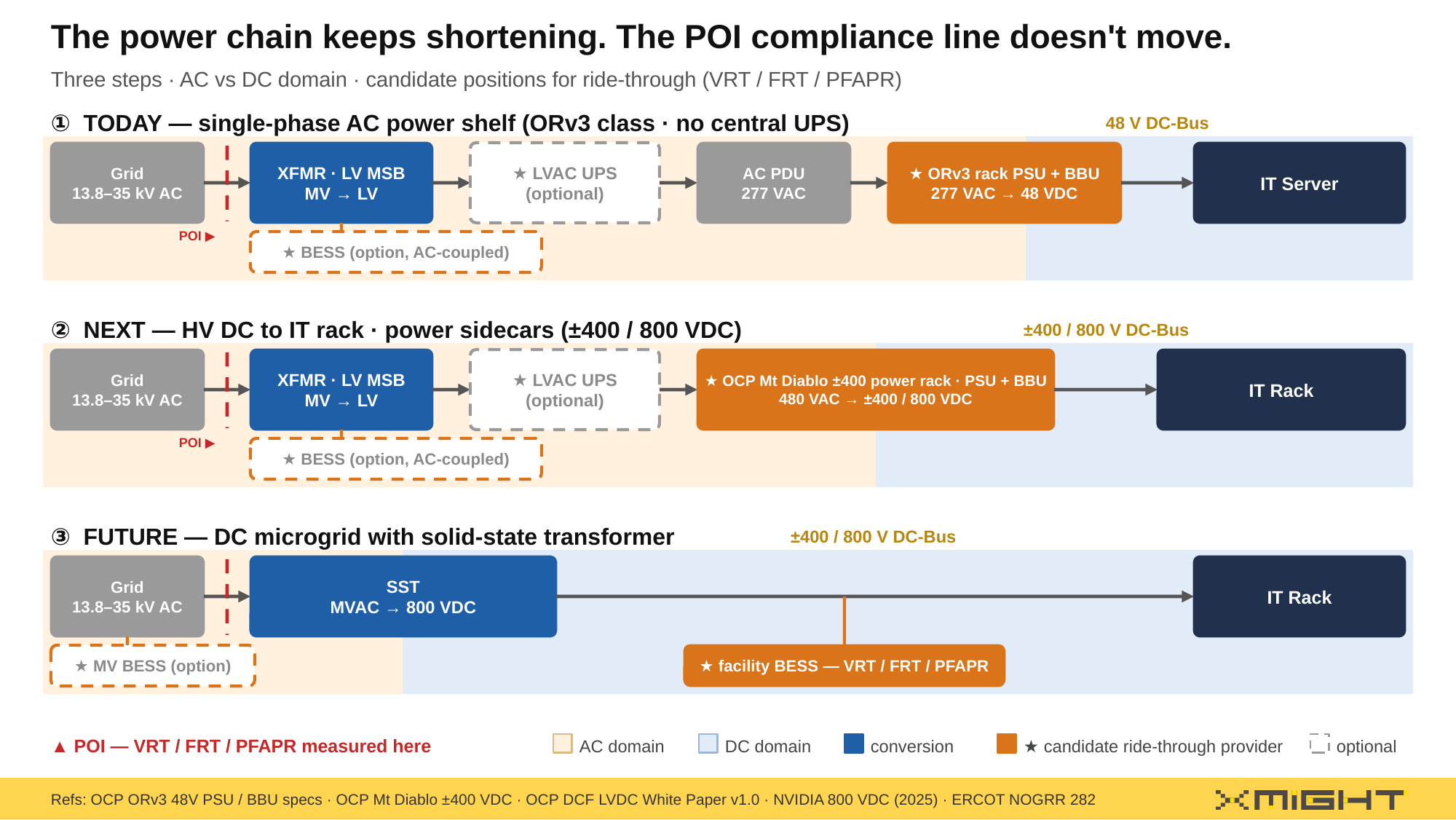
The power chain between the grid and the rack is getting shorter. The ride-through obligation is not.
The industry is walking three steps: single-phase AC power shelf today (ORv3 class); HV DC to the rack next (OCP Mt Diablo ±400 VDC), with power sidecars feeding a ±400/800 V DC bus; then a DC microgrid behind a solid-state transformer. Each step deletes conversion stages, and every deleted stage stops paying twice — once in its own losses, once in the cooling that removes them. The direction is set.
But every step also spreads the ride-through energy across more independent devices: central UPS → sidecar BBU → rack-tier storage. Each of those devices acts on local logic.
Grid codes pull the opposite way. ERCOT NOGRR 282, IESO's large-load requirements and NERC's emerging work define VRT, FRT and PFAPR at the point of interconnection: one aggregate, predictable, provable response — no matter how many devices sit behind the meter. And the POI curve is not one rack's behavior times N; it is the aggregation of thousands of independent restart and recovery decisions.
So the two compliance paths both carry a real cost. Grid-side BESS sits where compliance is measured and touches nothing in the IT power train — the natural retrofit for sites already built — but it is heavy capex, sized against worst-case aggregate load. Rack-DC storage is closest to the load and keeps the OCP no-UPS philosophy intact — but it brings standby losses, battery aging, thermal overhead, and multiplies the number of devices that must act as one.
Whichever side you pick, the missing piece is the same: coordination and evidence. IEEE IC25-004 calls for consistent behavior across multi-vendor systems and predictable site-level responses. That layer — the one that makes thousands of distributed devices behave as one auditable load at the POI — is the problem we work on at XMight Smart Energy.
The shorter the chain gets, the more this one layer decides who passes and who doesn't.
So here is my question for every operator planning capacity for 2027 and beyond: when the sag hits and you have to explain what happened — can you show which racks rode through, which restarted, in what order, against which deadline? An aggregate MW curve is not an answer. Rack-level evidence is.
If you cannot answer that today, let's talk — bring your hardest case.
References
- NVIDIA, 800 VDC Architecture Will Power the Next Generation of AI Factories (2025)
- OCP Mt Diablo ±400 VDC power rack (OCP Rack & Power)
- OCP DCF Power Distribution LVDC White Paper v1.1.0 (September 2026)
- ERCOT NOGRR 282
- IEEE IC25-004 (January 2026)