Texas changed how AI data centers must behave on the grid
ERCOT NOGRR 282 sets ride-through and recovery rules for large computational loads. Most of the lower stair-step does not exist in any current ORv3 spec.
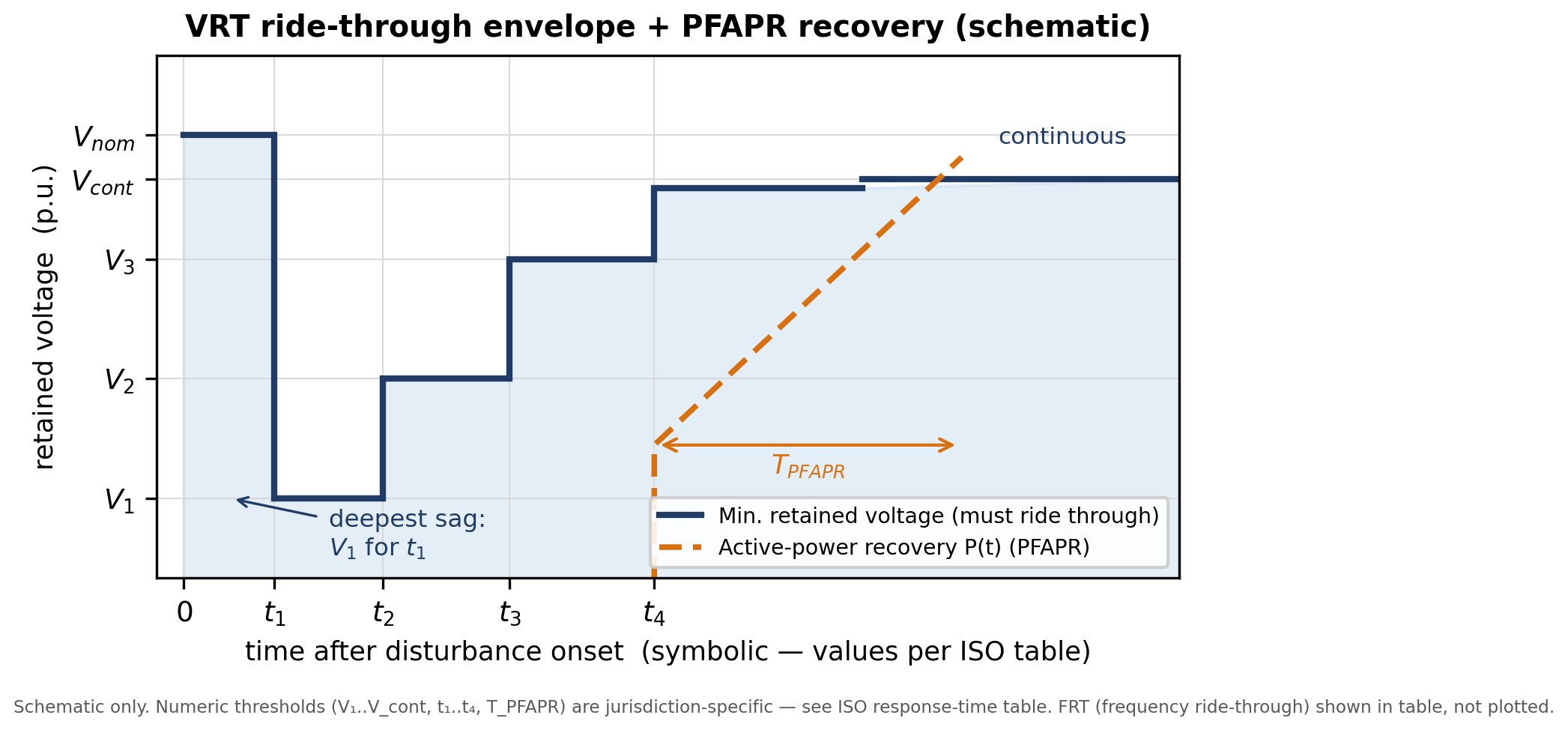
Update, September 2026. NOGRR 282 was filed in November 2025, approved by the Public Utility Commission of Texas on 9 July 2026, and has been in force since 1 August 2026. One provision — continued consumption in the 0.50–0.80 p.u. band — becomes mandatory on 1 January 2028. The figures below are corrected to the enacted text.
Texas just changed how AI data centers must behave on the grid.
Most ORv3 operators don't know yet — but they will, soon.
ERCOT filed NOGRR 282 in November 2025; it took effect on 1 August 2026. Any data center drawing 75 MW or more is classified as a Large Computational Load — and must:
- Stay connected during voltage sags to 0.5 p.u. for 0.5 seconds
- Stay connected at 0.35 p.u. for 0.25 seconds, and below 0.35 p.u. for 0.15 seconds
- Restore 90% of pre-disturbance load within 2 seconds of voltage recovery (0.5 seconds where the load transfers to an internal source)
The lower stair-step is what doesn't exist in any current ORv3 spec.
Why this matters at the rack level
A current 48 V PSU is rated 180–305 VAC. At 0.5 p.u. of a 277 V system, input drops to 138 V — below spec, undefined behavior, vendor-dependent. At 0.35 p.u. (about 97 V), the PFC cannot operate.
This isn't a single-PSU problem. When thousands of ORv3 racks each trip or restart on local logic, what the grid sees is a synchronized load drop — exactly what ERCOT is writing rules to prevent.
Reference event: Fairfax, Virginia, July 2024. Six successive faults over 82 seconds — and about 1,500 MW of data-center load disappeared from the grid in seconds.
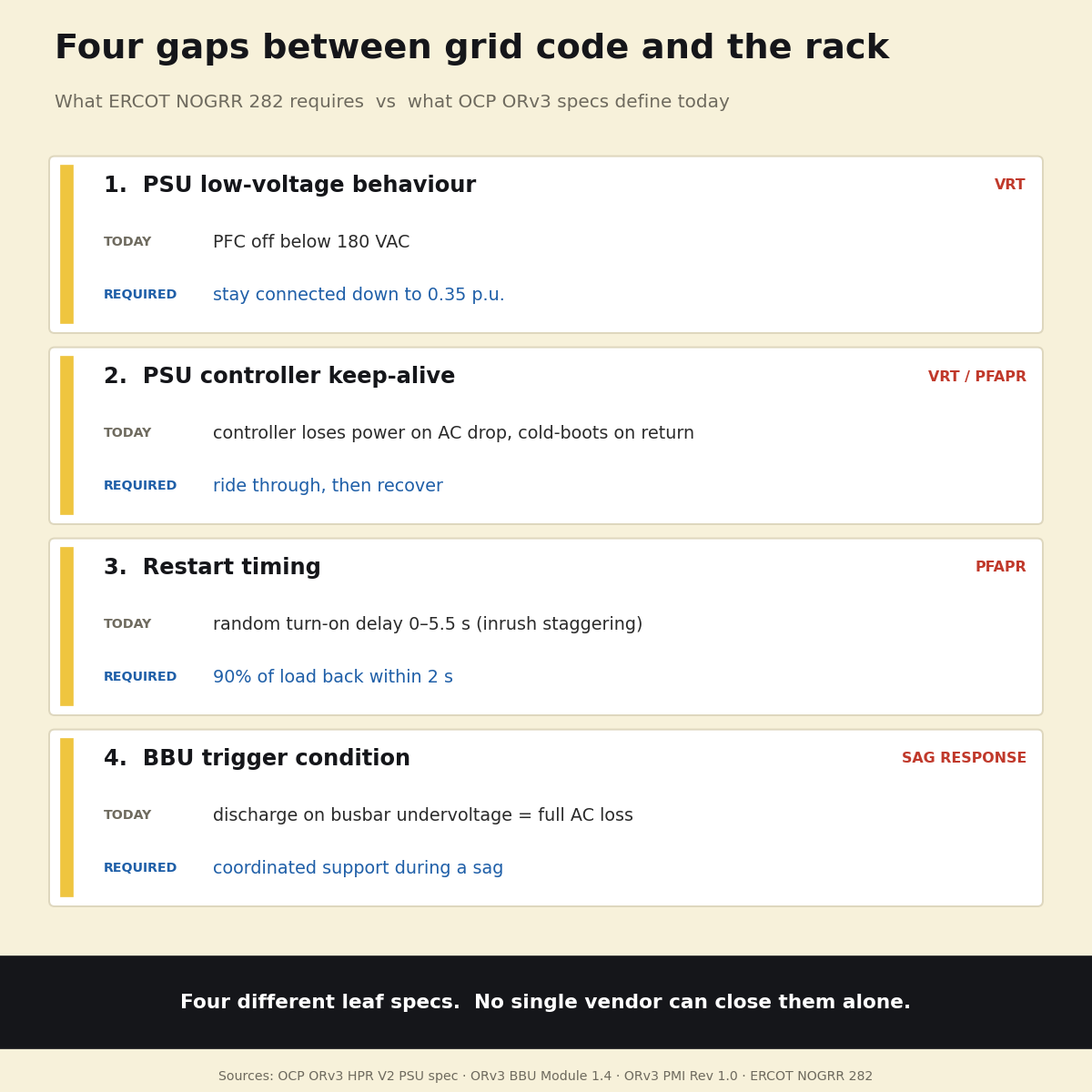
That's a problem rack-level architecture has to solve. Not just the data hall design.
The follow-on posts: ESS is the muscle, coordination is what's missing and The power chain is getting shorter.